Asia Communications and Photonics Conference (ACP2026)
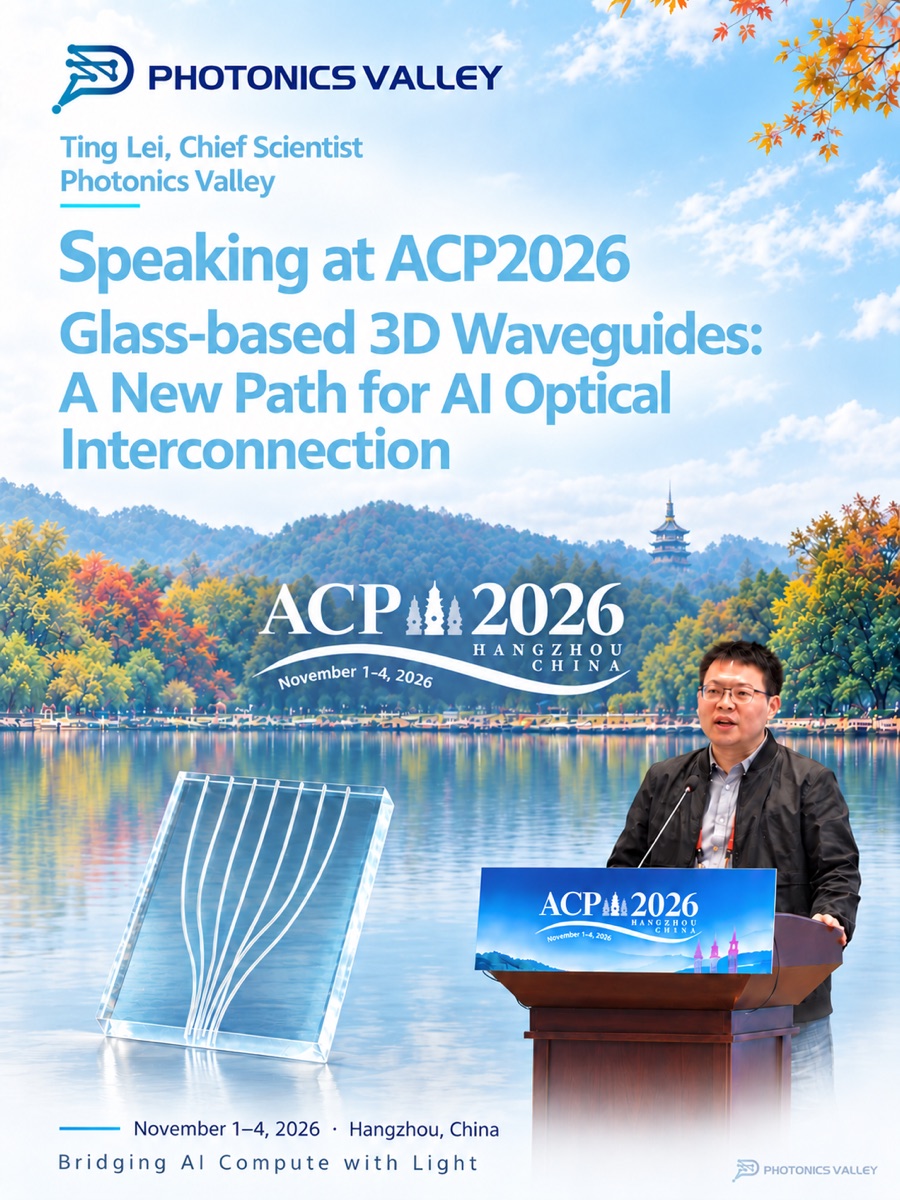
The Asia Communications and Photonics Conference (ACP2026) takes place in Hangzhou, Zhejiang, China, from November 1 to 4, 2026. Dr. Ting Lei, Chief Scientist of Shenzhen Photonics Valley Technology Co., Ltd. and Professor at Shenzhen University, attended the conference and delivered a presentation titled “Glass-based 3D Waveguides: A New Path for AI Optical Interconnection” in the “Advanced Optoelectronic and Fiber Packaging” session, sharing the company’s progress in glass-based 3D waveguide technologies and applications.
01 | Bringing Together Photonics Research and Industry
ACP is the largest academic conference in the Asia-Pacific region focused on optical communications, photonics, optical sensing, and emerging optoelectronic technologies. By December 2025, the conference had held 25 editions in cities including Busan, Hong Kong, Beijing, Shanghai, and Suzhou, providing an ongoing platform for exchange between researchers and industry professionals worldwide.
This year’s conference is jointly organized by Westlake University and Zhejiang University, with technical support from organizations including Optica, formerly the Optical Society of America (OSA); SPIE; the IEEE Photonics Society; the Chinese Optical Society; and the China Institute of Communications.
The session featuring Dr. Lei focused on co-packaged optics, advanced integration of photonic and electronic chips, and fiber-optic components—areas closely aligned with the growing demand for high-density optical interconnects in AI computing infrastructure.
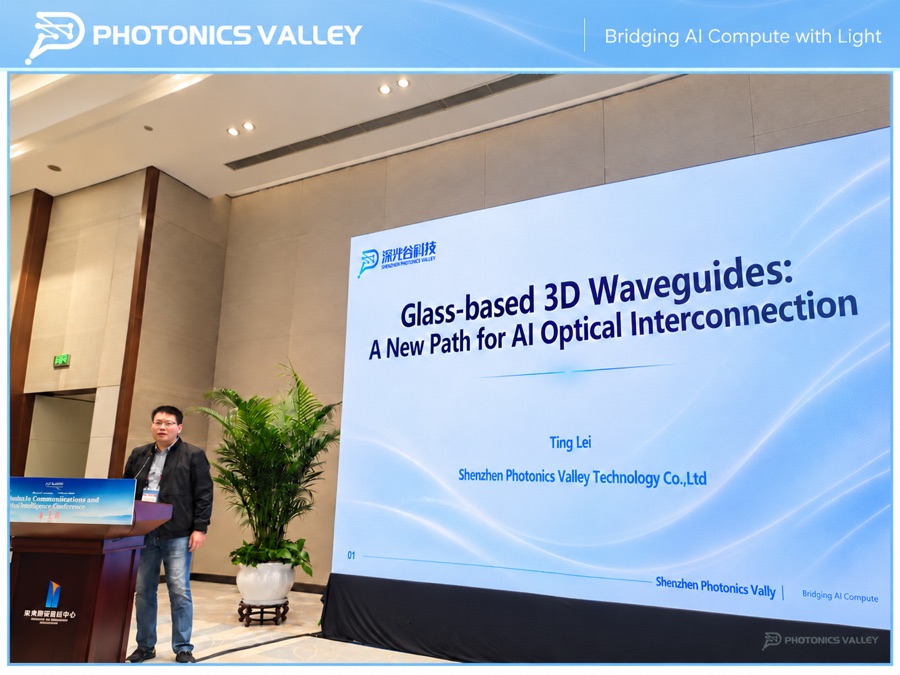
02 | About the Speaker: Dr. Ting Lei
Co-founder, Chief Scientist, and Technical Director of Photonics Valley; Professor at Shenzhen University
Dr. Lei has extensive research experience in optical field manipulation and optical communications. His research spans space-division multiplexing optical communications, high-capacity, high-speed optical switching, and free-space laser communications.
He has led research under China’s National Key R&D Program, a key project supported by the National Natural Science Foundation of China’s Regional Joint Funds, two NSFC General Program projects, and an NSFC Young Scientists Fund project. He has also led industry-sponsored projects with Huawei and projects supported by Shenzhen’s Distinguished Young Scholars program.
He has published more than 60 papers and received honors including the China Patent Excellence Award, an Outstanding Scientific Paper Award from the China Association for Science and Technology, and the Second Prize of the Shenzhen Natural Science Award.

03 | Glass-Based 3D Waveguides: A New Path for AI Optical Interconnection
Growing demand for AI computing is placing greater requirements on data centers for high-speed, high-density, and low-power optical interconnects. Addressing these needs, Dr. Lei’s presentation explored the application potential of glass-based 3D waveguides from three perspectives: operating principles, interconnection challenges, and manufacturing capabilities.
Building Three-Dimensional Optical Paths Inside Glass
Femtosecond laser direct writing creates optical waveguides inside glass, enabling flexible three-dimensional routing and channel arrangements. Combined with end-face processing, fiber array fabrication, and optical coupling and packaging capabilities, this approach turns optical routing designs into chips and devices for practical applications.
Connecting Multicore Fibers and High-Density Optical Interfaces
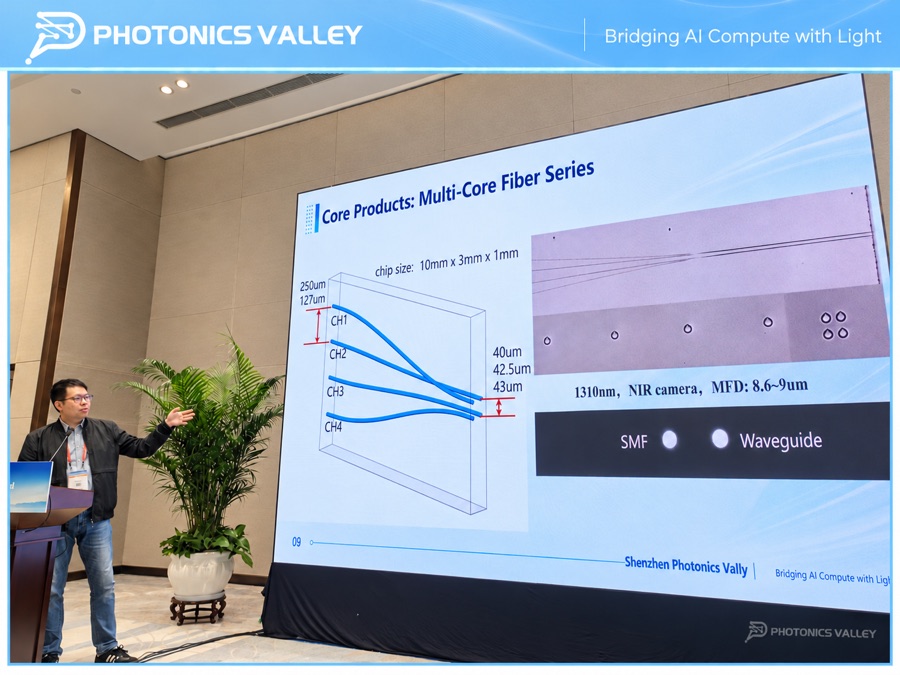
Multicore fiber systems require fan-in/fan-out connections between individual fiber cores and separate optical channels. Near-packaged optics (NPO) and co-packaged optics (CPO) also present challenges in adapting interfaces with fine pitches and multiple rows.
Three-dimensional waveguide routing enables transitions between different channel pitches and arrangements, providing a pathway to multichannel optical interconnection.
Advancing from Chip Fabrication to Wafer-Level Integration
The presentation also covered wafer-level fabrication of glass-based 3D waveguides, integration approaches compatible with through-glass vias (TGVs), and the company’s in-house processing and automated testing capabilities. Together, these developments outline a technology roadmap extending from core fabrication processes to manufacturing at scale.
04 | From Core Chips to Interconnect Assemblies: Enabling Practical Applications
Building on these technologies, Photonics Valley has developed a portfolio of chips, devices, and assemblies for multicore fiber interconnection, high-density optoelectronic packaging, and wafer-level integration.
Multicore Fiber Interconnect Products
The company’s multicore fiber fan-in/fan-out (MCF FIFO) chips and devices support four-core, seven-core, and customized configurations. Together with MCF-MT assemblies, they connect multicore fibers to individual optical channels, addressing the needs of high-speed optical transceivers and data center interconnects.
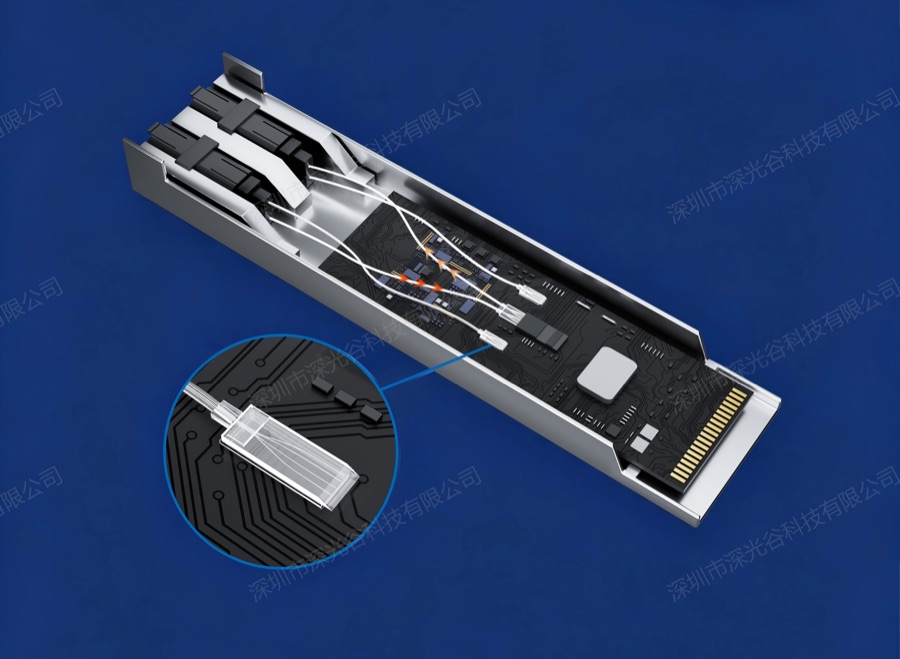
Figure 1. Application of four-channel and dual four-channel waveguides in optical transceivers.
High-Density Optical Interconnect Products for NPO and CPO
For near-packaged optics and co-packaged optics, Photonics Valley develops multichannel waveguide chips, high-density connectors, and detachable optical interconnect solutions. These products support connections between fine-pitch, multirow optical interfaces and standard fiber arrays or multicore fibers.
The illustrated pluggable connector maps 32 optical channels to eight four-core fiber interfaces, demonstrating an interconnection configuration between multichannel and multicore fiber interfaces.
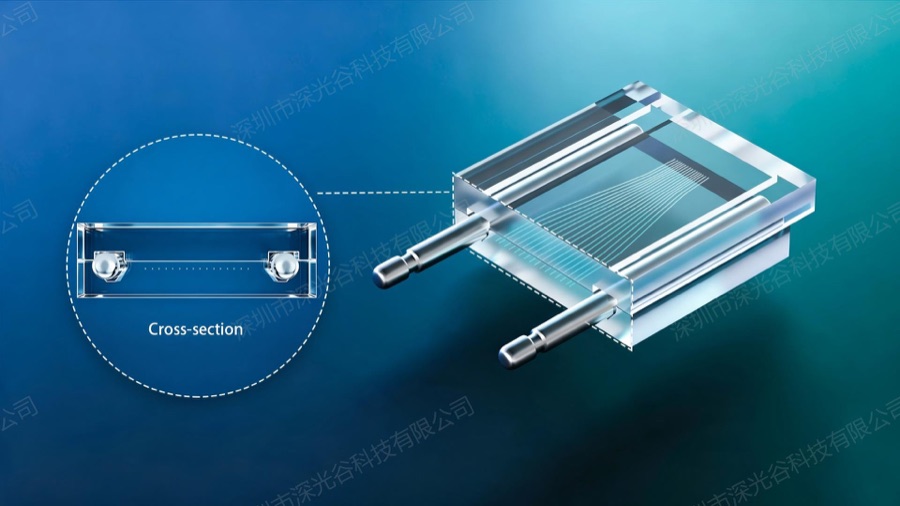
Figure 2. A 32-channel-to-eight-four-core pluggable connector and its cross-sectional view.
Wafer-Level Glass-Based 3D Waveguides
Photonics Valley is advancing wafer-level laser direct writing and customized three-dimensional optical routing. The company is also exploring glass-based optoelectronic integration compatible with TGVs, combining optical routing with advanced packaging to create further opportunities for high-density optical interconnect integration.
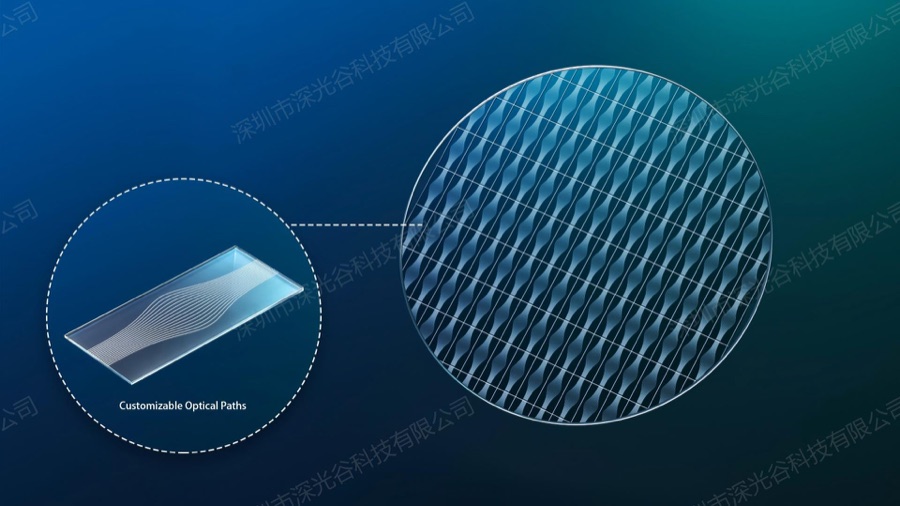
Figure 3. Schematic of a wafer-level glass-based 3D waveguide chip.
As AI computing infrastructure evolves, Photonics Valley will continue advancing the research, development, and commercial application of glass-based 3D waveguide chips and core optical interconnect devices. Through collaboration with research institutions and industry partners, the company aims to accelerate the adoption of high-speed, high-density, and low-power optical interconnect technologies.



